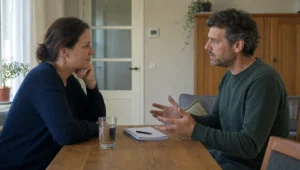
Coping with trauma often requires more than just time, silence, or sheer determination. You may still be functioning—taking care of others and keeping your work or family life running—while something inside you remains stuck. Professional help can provide support in these situations, not because you’re weak, but because some experiences were too much to bear on your own.
For many people, taking the step to seek help is a difficult one. There may be shame, doubt, or fear that someone else will decide what needs to be done. Especially if you’re well-known in your field, have a family, or are used to keeping everything under control, being open can make you feel vulnerable. Yet it is precisely a safe, discreet environment that can help you finally take an honest look at what’s going on.
Coping with trauma isn't a matter of willpower
Many people try to just carry on with their lives after a traumatic experience. That’s understandable. Your schedule keeps going, others are counting on you, and perhaps you’ve learned not to dwell too much on the pain. But coming to terms with it isn’t a straight line. Sometimes things seem calm for a long time, and then the tension resurfaces later through your body, relationships, mood, or behavior.
What appears on the outside to be stress, anger, avoidance, or fatigue may actually be a protective response on the inside. Your system is trying to prevent the pain from recurring. That may be helpful in the moment, but years later, that same response can limit your life.
So, when it comes to trauma, it’s not just about what happened, but also about what your brain and body had to do to cope. That explains why talking to friends, getting some rest, or rationally understanding what happened isn’t always enough.
If you'd like to first gain a better understanding of what a life-altering experience can mean psychologically, the explanation of what trauma is can be a good place to start.
Signs that it's becoming too much to keep going
Not everyone who has gone through a difficult experience needs intensive treatment. Some people find enough support from those around them, from a local therapist, or through practical changes in their daily lives. It’s a different story when symptoms keep coming back or when you find yourself just barely getting by.
The signs aren't always dramatic. Sometimes they're actually subtle patterns: you can't relax, you react more quickly than you'd like, you feel little connection with others, or you seek escape through work, alcohol, food, control, or withdrawal.
| Signal | How it can be noticeable | Why Help Can Help |
|---|---|---|
| Ongoing tension | Your body remains alert, even when there is no immediate danger | You'll learn to recognize and manage stress |
| Avoidance | You avoid conversations, places, memories, or emotions | You work step by step to build safety and resilience |
| Emotional flatness | You don't feel much, even toward people who are important to you | There will be an opportunity to reconnect |
| Recurring Patterns | You fall back into control issues, substance use, or overworking | The underlying function of the pattern is being investigated |
| Relationship Problems | Closeness feels threatening, or the conflict escalates quickly | You'll learn to understand reactions without judging yourself |
Professional trauma counseling can be especially helpful if your symptoms are affecting your daily life, work, or relationships. The goal is not to force you to relive everything, but to work together to identify what your system needs to experience more peace, control, and safety.
If you're unsure whether your symptoms might be related to this, it can sometimes help to compare common signs that appear after a traumatic experience with your own situation.
What Sets Professional Help Apart from Just Keep Trying
Many people who seek professional help have already tried just about everything. They’ve read books, listened to podcasts, cut back on work, adopted a healthier lifestyle, or sought counseling before. Sometimes that helps a little, but not in the long run. That can be discouraging, especially if you start to feel like you need to try even harder.
Good therapy doesn’t start with working harder. It starts with slowing down, creating a safe space, and understanding why certain reactions have arisen. An experienced therapist looks not only at symptoms, but also at the context: your history, current stressors, coping mechanisms, relationships, physical signals, and what has or hasn’t helped in the past.
The GGZ Care Standard for Psychotrauma and Stressor-Related Disorders emphasizes that care must be tailored to the individual, their symptoms, and their situation. That may sound obvious, but in practice, it is precisely that personalization that makes all the difference.
Professional help may include, among other things, counseling, body-oriented therapy, stabilization, psychoeducation, EMDR, or other appropriate forms of treatment. The appropriate approach varies from person to person. A safe intake process is therefore more important than trying to determine in advance which method will be the solution.

When Seeking Professional Help for Trauma May Be the Right Step
Sometimes outpatient care in the Netherlands is sufficient. In that case, you have enough stability, support, and flexibility to work on your recovery alongside your everyday life. However, there are situations in which more distance, intensity, and structure can be helpful.
This may be the case if you find yourself stuck in recurring patterns, if weekly sessions don’t provide enough support, or if your environment has become a source of stress. Think of work pressure, family responsibilities, relationship problems, or triggers that keep putting you in the same situation over and over again.
A more intensive program may also be appropriate when multiple issues are present at the same time. For example, exhaustion, depressive symptoms, substance use, anxiety, compulsive checking, or a case of burnout that just won’t fully resolve. In such situations, it is often necessary to look not just at a single symptom, but at the whole person.
Trauma therapy in a private setting can provide an opportunity to temporarily step away from the pressures of daily life. Not as an escape, but as a deliberate break during which, with guidance, you explore what lies beneath your symptoms and how you can start living differently.
In cases of acute danger, suicidal thoughts, or an immediate crisis, a private treatment center is not a substitute for emergency care. In such cases, contact your primary care physician, the after-hours primary care service, the crisis hotline, or call 112 if there is immediate danger.
Why Being Away from Home Can Sometimes Bring Peace of Mind
Staying at home has its advantages: you’re close to people you know, and your daily routine remains familiar. Yet that same environment can also cause you to keep falling back into old patterns. You remain available for work, family, the phone, obligations, and expectations. Even when you try to rest, your mind often stays active.
Distance can help because there’s less noise. In a different setting, you don’t have to explain as much, put on as much of a show, or worry as much about what others see in you. That sometimes makes it easier to be honest about shame, sadness, anger, or emptiness.
At Montgó Lifestyle, trauma is addressed through personalized attention, privacy, and intensive support. The location in the peaceful hills of the Costa Blanca is not an end in itself, but rather supports the treatment process: fewer distractions, more space for recovery, and an environment where comfort, structure, and professional care go hand in hand.
Private therapy in Spain can also be appealing to people who need discretion. This includes entrepreneurs, executives, professionals, parents, or people who feel they have little room to be vulnerable within their social circles. Being outside your usual environment can sometimes provide exactly the peace of mind needed to look inward.
What to Expect from a Thorough Process
A tailored process doesn’t start with a standard program, but with listening. What happened? What are you noticing now? What have you already tried? What are you afraid of? And what would you like to change in your life—even if it’s still hard to put into words?
Private care is all about a personalized approach. This means that therapy, structure, rest, lifestyle, personal guidance, and follow-up care are all tailored to one another. Intensity is only valuable if it’s approached with care. Going too deep too quickly can feel unsafe, while staying too superficial often doesn’t lead to enough progress. The right balance is found through connection.
For some people, EMDR is an appropriate method. For others, the first step involves stabilization, emotion regulation, restoring sleep, body awareness, or reducing numbing behaviors. You can find more background information on this form of treatment in the explanation of EMDR therapy.
Aftercare deserves just as much attention as the treatment itself. Returning home means returning to work, relationships, responsibilities, and potential triggers. Effective support therefore also focuses on this transition: what boundaries are necessary, who should be involved, which habits support recovery, and what should you do if old patterns resurface?
Also for family members, employers, and referring professionals
It’s not just the person themselves who can get stuck. Partners, family members, employers, and referrers may have noticed for some time that someone is exhausted, unresponsive, or acting differently. It can be difficult to help without pressuring them, especially if the person is in denial, downplaying the situation, or feeling ashamed.
A confidential conversation can then provide clarity—not to take over someone’s care, but to discuss what is appropriate, respectful, and feasible. Sometimes the first step isn’t admission or an intensive treatment program, but working together to determine what kind of care best fits the situation.
For employers and professionals, discretion often plays a major role. A person may have a great deal of responsibility and still feel stuck inside. Thoughtful support takes into account privacy, the work context, and a return to work, without reducing the person to their job performance or absenteeism.
How do you know if this is the right time?
There’s rarely a perfect time to seek help. Often, you don’t take that step until moving forward becomes more difficult than standing still. You don’t have to be completely sure of what you need. Doubt is part of the process, just like fear of change or uncertainty about costs, distance, and what others will think.
A good first step is a confidential conversation in which you don’t have to prove anything. You can talk about what’s going on, ask questions, and see if the approach is a good fit. That conversation can also cover practical concerns: work, family, housing, language, follow-up care, and privacy.
If you find that your life is becoming increasingly restricted, that your symptoms keep coming back, or that you’re mostly just getting by rather than truly living, professional support can be helpful. Not as a promise that everything will disappear quickly, but as a safe space to work carefully toward recovery, insight, and greater control over your life.
Frequently Asked Questions About Coping with Trauma and Seeking Professional Help:
When is it a good idea to seek professional help? It’s a good idea to seek professional help if your symptoms keep coming back, your daily life is being limited, or you find that you’re just barely getting by. Even if previous treatment wasn’t effective enough, a different form of counseling may be appropriate.
Do I need to know exactly what happened before I seek help? No. Many people mainly feel anxiety, emptiness, shame, or exhaustion without being able to fully understand what’s going on. A thorough initial assessment helps us calmly explore what’s going on.
Wouldn’t treatment in Spain be too far removed from my everyday life? In fact, that distance can provide support if you keep finding yourself caught up in the same pressures, roles, or triggers at home. However, it’s important to plan for your return and ensure you receive follow-up care.
Can a loved one or employer get in touch? Yes, an initial confidential contact can also be helpful for partners, family members, employers, or referrers who are looking for appropriate support for someone else. The privacy of the person involved remains a priority.
What if I'm not sure whether my symptoms are serious enough? You don't have to wait until things come to a standstill. Doubt is a good reason to seek information. In a confidential conversation, you can explore what kind of help is right for you, without having to commit to anything right away.
A Discreet First Step
If you feel that just carrying on isn’t enough anymore, the first step can be small and thoughtful. At Montgó Lifestyle, you can discuss what’s going on in a trusting environment and find out what kind of support might be right for your situation—or for someone you care about.
You don't have to make a final decision just yet. Sometimes recovery starts with a single safe conversation where you finally don't have to pretend that everything is okay.